


Introduction Bit Planes and Digital Image Layers
Smoothness is the attribute of digital images to the human eye. However, computer processing reveals that digital images consist of layered binary data. These hidden layers, known as bit planes, are the building blocks of how digital images are created and stored.
- Introduction Bit Planes and Digital Image Layers
- An 8-bit image is comprised of 8 bit planes, and includes:
- Constructing an Image with Bit Planes
- The Science Behind Bit Planes
- Significance of Bit Planes
- Bit Plane Slicing, an Advanced Image Processing Technique
- Bit Planes in Modern Applications
- The Study of Bit Planes
This write up, The Science of Bit Planes: Uncovering Digital Image Structure, attempts to explain how images are stored in computers as binary data, why it is important, and how it can be utilized in technology.
Realizing the importance of understanding bit-planes is integral to the understanding of technology and processing systems.
What Are Bit Planes?
Bit planes can be understood better by a basic understanding of how images are constructed using pixels. Pixels are the basic building blocks of images. Each pixel is represented as a number that defines its color.
In an 8-bit grayscale image, the color of each pixel can be represented as a number from 0 to 255. This number can be represented in a binary system using 8 bits. The bits of each pixel are arranged in layers known as bit-planes.
An 8-bit image is comprised of 8 bit planes, and includes:
– Bit Plane 0 (Least Significant Bit)
– Bit Plane 1
– Bit Plane 2
– Bit Plane 3
– Bit Plane 4
– Bit Plane 5
– Bit Plane 6
– Bit Plane 7 (Most Significant Bit)
Each individual plane contributes its own distinct level of detail.
Constructing an Image with Bit Planes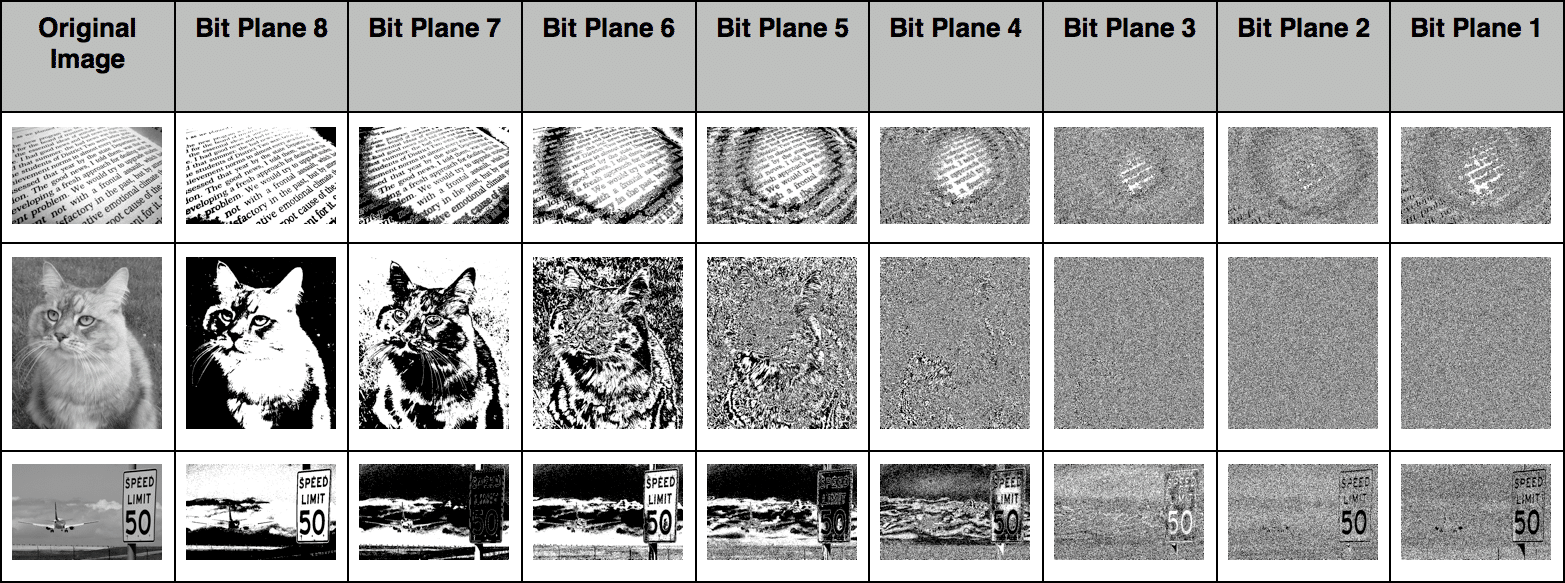
Every bit plane contains a binary value (0s and 1s) that occupies the same position for every pixel of the image. When all the bit planes are stacked together, they reconstruct the image.
Bit planes 6 and 7 are most significant, and contain the most information. They describe the structure and shape of the image and provide the highest contrast. Bit-planes that are 0 and 1 contain information that determine the finer details, and in a lot of cases, noise.
The image quality is determined in large part by the significance of the bit-planes that are included. Removing the highest significance bit-planes results in an image that is almost completely unrecognizable. Removing the lowest significance bit-planes results in an image that remains almost completely recognizable.
The Science Behind Bit Planes
The science behind bit-planes is simply a part of digital signal processing and binary representation. Every image can be thought of as a large array of numbers, and those numbers can be expressed in binary.
The distribution of information in an image can be analyzed by slicing the image across its binary digits. This is known as Bit Plane Slicing.
Bit plane slicing helps researchers understand how:
Different parts of an image contain varying levels of information
How images are affected by random interference
How a lossy compression scheme compromises rendered images
This method of analysis allows image engineers the opportunity to work with images in a more efficient manner.
Significance of Bit Planes
Bit planes contribute significantly in many facets of digital imaging and computer vision.
1. Image Size
Bit planes enable compression algorithms to shrink the image size by eliminating the less significant data found in the lower bit-planes.
2. Image Noise
Lower bit-planes contain more of the random noise. Removing them or filtering them helps improve the image.
3. Image Features
Adjusting specific bit-planes can improve the overall image quality and focal significance.
4. Information Security
Bit-planes assist in steganography. Information can be concealed in the least significant bit planes of the digital image.
Bit Plane Slicing, an Advanced Image Processing Technique
Bit Plane Slicing, a common technique in digital image processing, separates a digital image into its individual bit planes.
Higher bit-planes can be lower in an image, while lower bit-planes can be more significant. Bit Plane Slicing helps engineers understand this in more detail.
Bit Plane Slicing can be applied in a variety of ways in education and research.
Bit Planes in Modern Applications
Bit planes are a vital element of many emerging technologies.
Medical Imaging: Improvements in the detail of images of cross-section slices of the body
Satellite Imaging: Advanced analysis of changes in land and the biosphere
Artificial Intelligence: Preparation of image data prior to implementation of machine learning algorithms
Security Systems: Concealment and/or encryption of sensitive data
Digital Communication: Improved techniques for the image-based transmission of data
All of the above illustrates the importance of bit-planes in digital technology.
The Study of Bit Planes
The study of bit planes brings to light the hidden order of all images on the computer; what is seen as a simple image is in fact a complex collection of binary layers.
The study of bit-planes is important for the understanding of all techniques used to enhance images on a computer as well as the means of securing images. From all perspectives, the study of bit-planes is fundamentally important.
Bit planes encapsulate the fact that beyond the rational images people see are layers of ordered, rational, and hidden data.