
Introduction
Military history is littered with examples of the critical importance of camouflage in helping military personnel conceal and blend with their surroundings to reduce their visibility. Of the many camouflage patterns that have been designed and developed worldwide, few are as compelling and as influential as Flecktarn. With its ingenious multi-colored spotted design, Flecktarn has been a landmark design in military aesthetics and technology.
- Introduction
- Flecktarn’s Development
- Flecktarn Development and Testing
- Flecktarn Patterns, Designs and Colors
- The Effectiveness of Flecktarn System and Design
- Military Use Of Flecktarn
- International Influence of Flecktarn
- It has also gained a considerable degree of popularity among:
- Flecktarn Beyond the Military
- Flecktarn Limitations
- Flecktarn’s Cultural Value
- Final Thoughts
Flecktarn is not a design that has become exclusively military. This design is derivative of tactical design and functionality. The same principles and logic that make Flecktarn effective as a military camouflage design has inspired its adoption in tactical design and functionality in the civilian sphere.
This article is a comprehensive study of the military and tactical use of Flecktarn as a camouflage design and pattern.
What is Flecktarn?
Flecktarn is camouflage that uses irregular small spots that are dappled to create a pattern to assist concealment in a military context.
Flecktarn is a portmanteau of two German words:
– Fleck, meaning a spot, and
– Tarn, meaning to camouflage or conceal.
Essentially, Flecktarn describes a spotted design to camouflage in a manner that assists blending or dappled concealment.
Flecktarn is not like many traditional military patterns which use large irregular shapes as a design element. This camouflage relies on smaller, dappled patterns that assist in breaking the outline of a person.
Flecktarn’s Development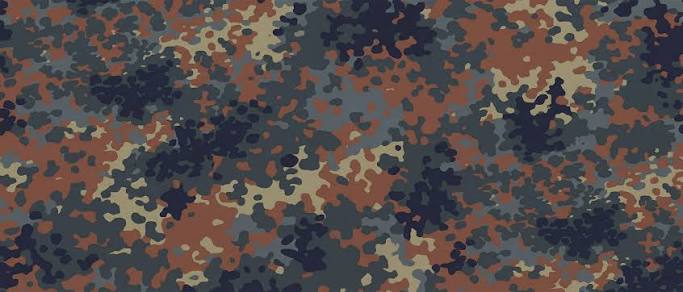
As modern military camouflage systems began developing in the late 20th century, Flecktarn was developed.
German military planners, in the post World War II era, developed their military planning, by incorporating studies of different camouflage and concealment systems. These studies investigated how patterns could be employed to enhance concealment, in different environments and how they would be revealed.
Flecktarn represents the system developed to conceal German military personnel against the European landscape of Forests, particularly Woodland.
Flecktarn Development and Testing
Developing Flecktarn required experimenting with patterns of different Colors, Shapes and Arrangements.
Among other things, developers researched how to accomplish a pattern with which they could:
1. Blend with forest environments,
2. Work at different distances,
3. Conceal the Wearers outline, and
4. Adapt to varying light.
The Spotted design was selected, because of the numerous irregular dissociated shapes and color variations of the natural environments.
Flecktarn Patterns, Designs and Colors
What is perhaps the most identifiable feature of Flecktarn, is the unique color selection of the design.
Typically, the colors of the Traditional Flecktarn Patterns contain:
1. Various Shades of Green,
2. Brown,
3. Black, and
4. Light colored spots.
These help mimic woodland environments as small, irregular spots help conceal the outline of the wearer.
The Effectiveness of Flecktarn System and Design
The concealment provided by Flecktarn, is based on a principle, Disruptive Camouflage.
Disruptive camouflage distorts the outline of an object instead of concealing it completely.
The human eye is naturally geared to search for patterns and outlines. Flecktarn attempts to reduce this effect by providing a complex visual texture.
The pattern:
Blends with vegetation
Reduces contrast
Increases visual confusion
Increases the difficulty of detecting movement
Military Use Of Flecktarn
Flecktarn is primarily meant for military concealment.
It was introduced as standard issue for the German armed forces.
Flecktarn is used by military personnel to camouflage:
Field uniforms
Combat clothing
Equipment covers
Clothing used for outdoor military operations
Flecktarn illustrates the necessity to modify military clothing for specific operational environments.
International Influence of Flecktarn
Flecktarn was designed in Germany; however, it has a considerable degree of international influence.
Numerous countries and organizations have either developed or researched camouflage systems influenced by the effective and distinct design of Flecktarn.
It has also gained a considerable degree of popularity among:
Outdoor enthusiasts
Tactical gear users
Military collectors
Military history communities
The distinct appearance of the pattern has a considerable degree of international recognition.
Flecktarn Beyond the Military
Flecktarn is no longer exclusively a military camouflage pattern.
Flecktarn can be seen on:
Outdoor and hunting gear
Fashion items
Backpacks
Apparel
Collectible items
Due to its unique appearance and historically inspired military design, Flecktarn draws considerable interest.
Benefits of Flecktarn
Flecktarn has many beneficial features.
Blends Well with Woods
Especially in forested/bushy environments, the colors of Flecktarn work well.
Distinct Appearance
The spotted camouflage pattern is memorable and makes a strong visual impact.
Versatility
Flecktarn can be used for multiple kinds of clothing and equipment.
Historical Value
It shows how far technological advancements in camouflage have come.
Flecktarn Limitations
Flecktarn is effective in many settings, but no camouflage can be effective everywhere.
Flecktarn’s effectiveness is dependent on:
Geography,
Light Conditions,
The Environment,
and Distance.
Camouflage can even be less useful in different environments such as desert, urban, and snowy settings.
This can be one of the reasons why many modern armies use different camouflage for different environments.
Flecktarn’s Cultural Value
Flecktarn has secured a strong cultural identity even outside of its utility.
Many military hobbyists and collectors can recognize Flecktarn all around the world.
Because of its striking design, Flecktarn has one of the most prominent camouflage designs in recent history.
This design is a key representation of technological design modern military thinking and design.
The Respect Flecktarn Holds .
Flecktarn is one of the successful camouflage designs of modern military thinking and design and will continue to be valued, even with modern military thinking and design camouflage that incorporates tech like advanced digital design and adaptive systems.
Final Thoughts
Flecktarn brought a lot of innovation to military design. Because of its spotted design and useful functionality, Flecktarn is one of the most prominent camouflage systems on the globe.
Flecktarn began in the militaristic development of Germany and grew to influence the tactical and outdoor communities. It originated at the intersection of nature, tech and great design. Because of its design, a camouflage pattern can be a tool of utility and a design that sets a trend.