

Introduction
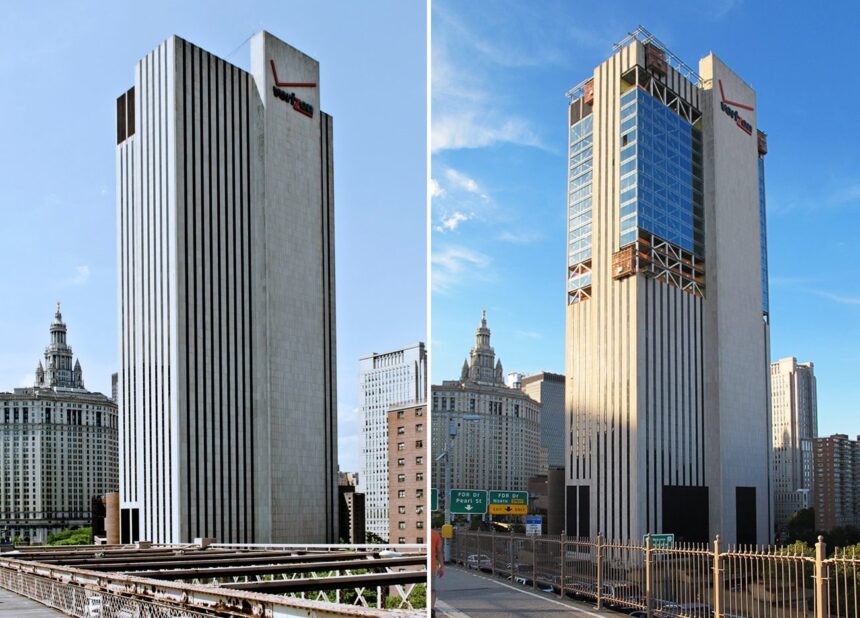
375 Pearl Street, one of the most unconventional skyscrapers in New York City, is interesting for the raw, utilitarian presence it adds to the Lower Manhattan skyline. A story of construction and urban change, technology and utility, this building reveals itself every step of the way.
375 Pearl Street is the antithesis of how most famous New York Towers were conceived. While most of the towers cater to the desire for a visually impressive edifice, this tower was designed and constructed to be a major telecommunications hub. It epitomizes the role of the building in the modern digital world and the flexibility inherent in the built world to serve the needs of changing technology.
375 Pearl Street’s Original Purpose
375 Pearl Street’s original construction was completed in 1975 and was built for the New York Telephone Company. This was not a typical 1970s office or high-end commercial building. This was a building constructed to accommodate large, bulky telephone switching equipment.
At the time the communications networks were large, cumbersome, and required a lot of machinery to be suspended in space. The building played a vital role in the telephone network in the city, and in calling out to the rest of the world.
It achieved functionality better than anything imaginable. Aesthetics and design features took a back seat to strength and reliability.
Architectural Design and Unique Structure
375 Pearl Street’s strongest feature is perhaps it’s fortress-like design. The majority of the 32 story building is constructed is reinforced concrete and contains very few windows.
Surrounding buildings cannot compare to the strength of 375 Pearl Street and it’s intentional, yet unique design. The strength and stability of the building were designed to support large equipment that would be extremely heavy and also not cause vibrations to the sensitive electronic systems that were contained throughout the building. The design of the building also left large, unbroken, open spaces to be able to accommodate the large equipment and also ended up leaving the building a stark contrast to the glass and steel towers that surround it.
Some people may argue it is one of the less attractive buildings in Manhattan, however, it’s honest. It may be a utility structure, but at the end of the day, it is a design that was built and serves its purpose.
Changing Technology and Declining Use
With the evolving technology, many large, centralized telephone systems began to be redundant due to the new digital telecommunications, new networking and fiber optic systems.
By the end of the 20th century, 375 Pearl Street was no longer as important to telecommunications systems as it had once been. This also began to pose a new question to address: a large, uninspiring but highly functional utility building.
Rather than demolishing the building, this began a new chapter in the buildings esthetic by bringing new life and purpose to the structure.
Evolution to a Data Hub
Undoubtedly, the most substantial change to 375 Pearl Street has been modernizing the structure into a data center. The building now supports multiple systems for digital communications, the cloud, and internet infrastructure.
Fortunately, for the structure’s new purpose, the building was designed to support many of the needs of infrastructure for telephonic systems and now supports servers and data networks. Some of the needs and former systems now found in the data center:
Structures built to support heavy systems and equipment.
Power systems built to sustain heavy and continuous operations.
Systems support a relatively secure environment.
A reliable communications network.
All of these things justify the building’s strong position and support its growing value to the digital economy.
Value to the Electronic World
In today’s business world, data centers are critical. Every online purchase, every corporate communication via the cloud, every video sent electronically, all support the systems housed in 375 Pearl Street.
While most of the city’s residents may not think of the building and all of the systems and operations it supports, it provides:
Support to multiple Internet Service Providers.
Support to financial trading networks.
Support to cloud systems.
Support to enterprise data systems.
Support to telecommunications data systems.
Because of all the support the building provides, most of the building’s systems and operations are under appreciated.
View of the Building
375 Pearl Street has generated a lot of discussion among architects, urban planners, and the city’s residents over the years. Most of the criticism concerns the building’s bulk, and the heavy design makes the building appear windowless.
Supporters say the design shows a different kind of honesty. It was never meant to meet a standard for beauty, it was meant to support greater efficiency.
It recalls a time when there was a focus on functionality over aesthetics in the design of buildings, especially in places like New York, where things were developing quickly.
A Reflection of Flexible Cities
375 Pearl Street is a clear depiction of changing building usage in cities. With the many adaptations seen in cities, instead of demolishing obsolete buildings, there has been a trend to transform these buildings in an effort to suit the needs of citizens.
Older buildings can also have a lot of resources that, with the appropriate technology, can be preserved and reused.
With that said, this building is also a symbol of the evolution and changes in technology.
Final Thoughts
125 Pearl Street reflects a journey of communication and transport technologies. What was once a telephone switching building has been successfully adapted to the needs of transport technologies of the modern world.
While the design of the building can be controversial, the use of the building has only continued to grow in prominence. The building exemplifies that the design of a structure is not the end of the building’s worth, but rather the building’s potential to transform and continue serving society.