

An In-Depth Review of the Cox–Ingersoll–Ross Model
Central to modern financial mathematics, is the CIR model, which describes the dynamics of interest rates. Named for its creators, this model has become a standard in both the pricing of financial instruments and in the management of financial risk. Developed by John Cox, Jonathan cox-ingersoll-ross, and Stephen Ross, this model describes the behavior of interest rates in the financial market.
The model is appreciated for its mathematical elegance, as well as, the practicality of its results. Much of the introductory financial mathematics literature is populated with models of simple constructions that result in negative interest rates. The CIR model approaches the mathematics with constraints that lead to realistic results.
The Cox-Ingersoll-Ross Model Explained
At its core, the CIR model is simply a stochastic process with a clear set of mathematical assumptions regarding interest rates. Interest rates tend to be influenced by two types of factors:
A tendency to revert to a long-run average
Random deviations caused by market disturbances
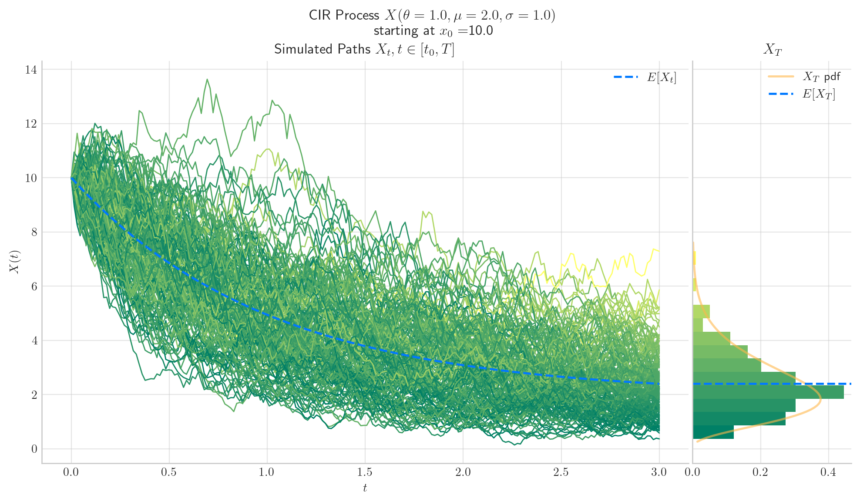
In finance, this is known as mean reversion, and in this case, it describes the tendency of interest rates to revert to a long-run average.
The mathematical form of the CIR model is:
dr = a(b − r)dt + σ√r dW
Where:
r = current interest rate
a = speed of adjustment toward the mean
b = long-term average interest rate
σ = volatility factor
dW = random shock (Wiener process)
This equation combines both the predictable forces of the economy and the unpredictable forces of the market.
How the Model Works in Practice
The cox-ingersoll-ross framework models the ways in which interest rates change over time. If interest rates are forecast to be too much greater than the average, the model predicts that rates will fall to that average. The same idea works in reverse; interest rates that are too low will be forecast to rise.
This mean-reverting behavior is seen in all financial systems due to the forces of central banking, the financial markets, and business cycles. All these forces push interest rates towards the same point.
The square root part (√r) means interest rates will remain non-negative. This is very important today as when interest rates do go negative, all financial models do become highly disfunctional.
Key Features of the Cox-Ingersoll-Ross Model
Several important features have contributed to the popularity of the cox-ingersoll-ross model.
1. Mean Reversion
Rates will always tend towards a balance.
2. Non-Negative Interest Rates
Realism in modeling is improved due to rates staying positive.
3. Random Market Behavior
Modeling of irrational market behavior is included.
4. Mathematical Stability
Modeling the prices of certain derivatives is helped by closed-form solutions.
Applications in Contemporary Finance
The cox-ingersoll-ross model has made its mark in academic spheres and in practically every segment of the financial systems.
After the model was developed, practitioners, especially in the following arenas, benefited:
1. Pricing of Bonds
Most applications in this sphere involve estimating the path of interest rates to price zero-coupon and other fixed-income bonds.
2. Pricing of Derivative Instruments
The CIR model comes in handy to price interest rate derivatives, swaps, futures, and options.
3. Quantification and Management of Risk
The CIR model assists financial institutions in measuring exposure to volatile interest rates.
4. Predictions of the Economy
The model helps economists by providing different scenarios of interest rates based on the state of the economy.
Benefits of the Cox–Ingersoll–Ross Model
Thanks to the balance of realism and simplicity, the cox-ingersoll-ross model is one of the most trusted models:
Eliminates negative interest rate scenarios
Captures the long-run disequilibrium behavior of the economy
Applicable to a myriad of financial instruments
Well grounded in stochastic calculus
These traits are appreciated by users in both academia and the financial industry.
Shortcomings of the Model
Like any model, the cox-ingersoll-ross model has its drawbacks:
Assumes constant parameters over time
May fail to capture the severity of extreme financial
The model is also complex to calibrate to the market.
To counter the limitations of the model, practitioners often supplement the model with advanced models.
Final Thoughts
The cox-ingersoll-ross model is a very valuable model in the sphere of applied modern financial mathematics. It has integrated the ideas of stochastic processes with mean reversion. Thus, the model provides simplicity, elegance, and usefulness in the behavior of interest rate dynamics.
Its applications are numerous and significantly valuable, ranging from bond pricing, to risk management, to economic forecasting. Despite more advanced financial models existing today, the CIR framework is still fundamental to quantitative finance as it is one of the clearer and more stable models that allow for practical application.