
Introduction to The Oregon Flag
A flag can be so much more than something that flies or is held during a ceremony. A flag can tell the visual story of the history and identity of a region. For a long time, the Oregon flag has been one of the many artifacts that can tell the story of the people and the symbol Oregon continues to be. The two-sided flag is designed to be distinct and reference history; the traveling story of the Beaver State is of pride to the Oregonian people.
The imagery and color of the Oregon flag is home to its own history, from the symbols of the land that are heritage to its people, to traces of revolution.
Oregon Flag History
Histories are rich, but states can be new; so, like many states before it, Oregon was state-like and flag-less. A symbol was longed for as Oregon grew into itself, expressing the history and resources of the land and the state’s ties to the union.
In 1859, Oregon entered the union as the 33rd state. Thereafter, officials sought to design a state flag. The state flag was to embody history, the environment, and government.
February 26, 1925 marks the date where the current flag of Oregon was officially adopted as a permanent symbol for the state.
The Oregon Flag
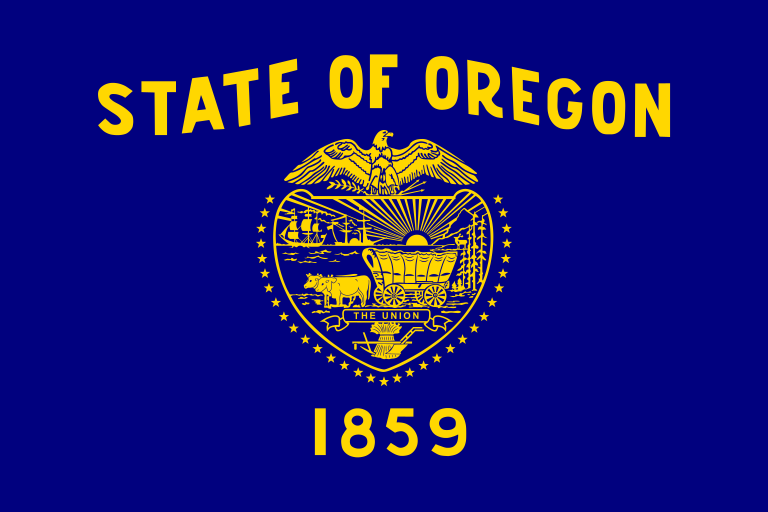
The Oregon flag has a dark blue field with gold writing and symbols. The flag’s front and back hold different images, a feature that no other state flag in the United States has.
The front shows the Oregon state seal with 33 surrounding stars. These represent Oregon’s order of statehood as the 33rd state. The name “State of Oregon” is written above the seal with the year “1859” printed below, the year Oregon became a state.
The flag’s back has a gold depiction of a beaver, Oregon’s state animal. This adds a unique design element to the beaver and also adds to the Oregon flag’s uniqueness as the beaver is a state animal.
The Oregon State Seal’s Meaning
The seals of states are symbols of the history and the present of the state. The Oregon state seal is no different.
Strength and loyalty to the United States are symbolized by the eagle. Protection is the shield; and the forests and agricultural scenes represent Oregon’s resources and beauty.
The seal also has a plow, a pick, and wheat. These symbols represent Oregon’s early industries which formed a base for the state’s economy.
A covered wagon symbolizes pioneers establishing new settlements and community growth in the state after traveling west.
The Importance of the Beaver Symbol
A very important part of the Oregon flag is the beaver, the only animal on any state flag in America. A direct link between the beaver and Oregon is in the story of the early years of the Oregon fur trade.
Throughout the 1800s, the beaver and their pelts were very important to the economy and identity of the Oregon region of the Pacific Northwest.
Even with all of its historical importance, the beaver also symbolizes hard work, creativity, and determination. These are all qualities of the modern spirit of Oregon.
How the Oregon Flag Represents Modern Identity
Much of what Oregon is today – innovative, conscious of its impact on the environment and its people, and a place of great natural beauty – is represented in the Oregon flag as the modern values of the state.
This combination of modern and historical thinking is represented in the design of the flag’s forests and mountains and the spirit of its wildlife and pioneers.
For citizens of Oregon, the flag is about their connection to the landscapes and culture of the state and is not just a representation of the government.
Why the Oregon Flag Stands Out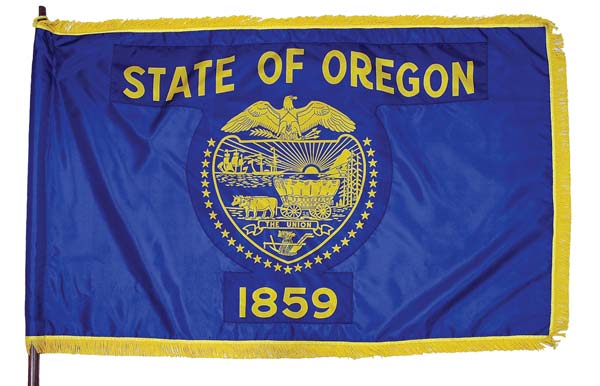
Because of the amount of creativity and history that it holds, combined with Oregon’s two-sided design, it is truly unique among all state flags as the only flag with two different designs on each side.
This unique aspect embodies Oregon’s motivation to honor both formal history and history exuded through the state’s ecology. The beaver and the state seal together result in a whole identity for Oregon.
The Oregon Flag
The Beaver State’s flag was adopted in 1925.
Its design is unique in that both sides are not uniform.
The state animal, the beaver, is found on the obverse.
The 33 stars signify Oregon’s standing as the 33rd state in the union.
The color scheme of blue and gold represents loyalty, resources, and prosperity.
The Oregon flag is an important symbol of the state’s history and transformation, as well as the stories and experiences of its people. From the early days of the state’s history and the flag’s design to the modern day, the state flag’s design commemorates a pivotal element in the Oregon’s progress.
The seal of the state represents the accomplishments of Oregon’s history and the beaver represents its wilderness and pioneering spirit. Despite the many generations of change, the flag of Oregon has remained, across generations, a symbol of pride and hope that links the past of the Beaver State to the present and future.